
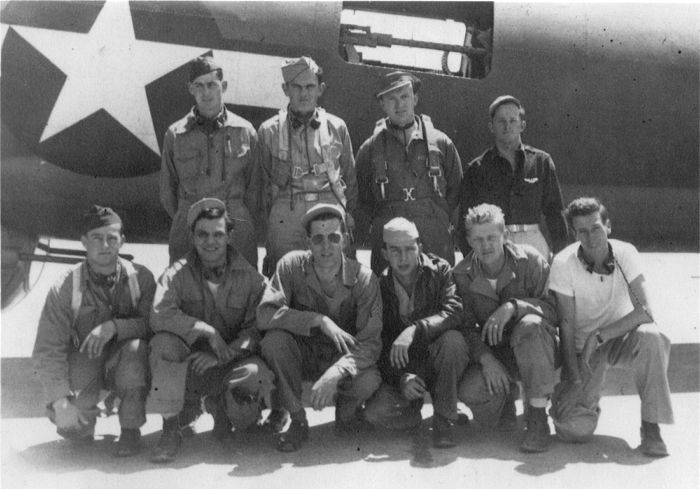
Walthall's Crew


LT Walthall's Crew at Rapid City, ND before deploying overseas.

Standing (L to R): Quentin F. Ingerson (N), Harvey M. Walthall (P), William J. Myers (CP), Howard S. Graham (B). Front (L to R): Kazmer Rachak (FE), J. Hesner (WG), Kenneth Faber (RO), James W. Danno (BG), William W. Lambertus (TG), William F. Dold (WG). Photo courtesy of Quentin Ingerson.

Next

The Walthall crew arrived in late July as the 486th was making the transition from B24s to B17s. The crew was given a week to train and prepare for combat. During this time they made one familiarization flight over England before their first combat flight on August 2nd. Two days later, on their second mission, the crew would not return.

The mission was off to a bad start when take off was delayed by 1/2 an hour due to fog. By 0900 hours the fog had lifted sufficiently to allow take-off of the aircraft. The 486th was supplying two groups of 20 B17s each, and would make up the "C" and "D" groups of the 92nd Combat Bombardment Wing. The 487th, stationed near Lavenham, would make up the "A" and "B" groups, and would have the lead. The 486th "A" group (serving as the "C" group for the 92nd CBW) assembled at their assigned altitude of 5,000 feet. The 486th "B" group (serving as the "D" group for the 92nd CBW) assembled at 6,000 feet.

The radio beacon at station 174 (called Buncher 22) was not working during the assembly. It was decided to fly both groups northerly toward Buncher 12 while they waited to assemble with the 487th. As they were flying back over station 174 Buncher 22 came on the air. The 487th arrived a minute late, forcing the 486th formation to execute a series of "S" turns to get into proper position behind the 487th. Once the Wing was assembled they flew back to Buncher 12, then turned NE to Buncher 9. From there they assumed an easterly course toward the radio beacon Splasher 9 near the coastal city of Lowestoft. At 1113 hours (one minute late) the bomber stream crossed the English coast at 13,000 feet, and turned NE to climb to altitude cruising altitude.

The formation continued its climb at 190 feet per minute to 12,300 feet on a course of 058° true for a distance of 204 miles. At this point they turned easterly, continuing their climb. At a position 35 miles NW of Heligoland, the bomber stream turned SE, giving the FLAK batteries at Heligoland a wide berth. At 1251 hours the 486th made landfall NNW of Bremen, at which point they turned toward Bremen. They were now well into enemy territory, and on their toes. Unfortunately, when abreast of Bremen they encountered a FLAK zone that S-2 had not known about.

The first casualty was the Adler crew flying #949 fell from formation at 1304 hours. The German FLAK was light but accurate. The group may have become confused, with some aircraft taking evasive manuevers. If true, the planned turn near Bremen became more complicated. While making the turn east of Bremen, near the city of Quelkhorn, a mid-air collision between two 832nd aircraft of the low squadron happened at 1308 hours. The Walthall crew in #909 had been flying #2, or right wing. The Harper crew in #145 was flying #3, or left wing. What happened next varies depending on whose perspective you consider.

LT Walthall reportedly was having trouble maintaining his position in the squadron. The crew of LT Harper's ship was trying to keep an eye on the Walthall ship. Initially it was planned to have the Walthall crew fly the diamond position (#4), but during the assembly the ship piloted by Dale and Walthall had traded places. LT Harper, and his copilot, LT Scully, had been switching piloting duties back and forth as was customary. After having handed control of the aircraft back to LT Harper, LT Scully (copilot) asked the tail gunner for a report on the Walthall crew. The bomber stream had entered the turn to the pre-IP and Walthall, in #909, could not be seen by Scully or the tail gunner. While in the turn LT Walthall found himself encroaching on the plane piloted by LT Harper when tragedy struck.

According to an eye witness account provided at the mission debriefing, a burst of FLAK detonated beneath #909, and the shock pushed the aircraft upward into #145. However, that report is inconsistent with first hand accounts. Aboard #145, LT Scully saw #909's left wing tip swing up between engines #3 and #4 on the starboard side. The shaft of #4 broke when it was struck by the wingtip of #909, and went flying off into space. The right wing tip was also lost. #145 began to settle, and #909 found itself beneath the stricken bomber. SGT Kazmer Rachak, flight engineer for the Walthall crew, watched in horror as #145 came down over their right wing, with their tail section coming down between #3 and #4 engines of #909. Damage to #145 was severe, but its empennage held fast as both aircraft started their tumble from the sky. Meanwhile, the Dale crew flying #942 in the slot, or diamond position, had to manuever up and out to avoid colliding with debris and tumbling aircraft.

[WEBMASTER NOTE: Post analysis of the collision leads to the conclusion that the two aircraft did not have synchronized turns, and wound up encroaching on each other. Harper, banked to the left, could not see #909, which was in his blind spot. Walthall, on the other hand, saw the distance decreasing and took action to avoid a collision. Unfortunately, his manuever had the affect he was trying to avoid. Having hit #145, Walthall may have put his ship into a short shallow dive to clear. Initially, the unbalanced torque of the 3 remaining engines, and the unbalanced lift resulting from the loss of a portion of its wing, may have caused #145 to rotate toward level, thus increasing its turn radius. Consequently, #145 now found itself on the outside of the turn, and over #909. As it settled down, it came down upon #909 as noted above.]

The impact knocked SGT Rachack to the flight deck, and debris from the propellers digging into the hull of #145 shattered the top turret dome. SGT Rachak immediately made his way to the forward hatch with the intent of bailing out fearing that the ship was doomed. As he passed by the nose compartment where the bombardier and navigator sat he waved to them to bail out, too. LT Ingerson, Navigator, urged the SGT out, since he was already in the escape trunk then followed closely behind.  Most likely, the ship went into its dive at this moment trapping the bomardier, Graham, and the rest of the crew inside until it could be brought back under control. LTs Walthall and Myers continued to fly there stricken B17 with the remaining crew.

During their dash for England the crew should have salvoed their bomb load to lighten their load, and stay aloft longer. Other equipment may have also been jettisoned, but there is no evidence for this. The extent of the damage to the #3 and #4 engines is not known, but it was apparent that the damage was sufficient to force the pilot and copilot to find a place to land. The fell short of friendly territory by less than two dozen miles, and chose the East Friesland Island of Borkum, Germany, NW of Emden, and near the border with the Netherlands. The island had actually been two, but were joined by an isthmus of land, and then their northwestern beaches were joined by a dike forming a mudflat in the interior. Eyewitnesses say the aircraft came straight in from the NE and momentarily disappeared below the dike from where they were standing. Whether intentional, or a miscalculation, the aircraft slid up onto the dike, over the top, and settled on its nose and left wing tip on the other side of the dike. Damage reports from eyewitnesses are mixed, and cannot give an idea of the damage to the aircraft not related to the belly landing.

During the approach of #909 the defenders of the island were putting up a fusillade of small caliber munitions. The aircraft passed the Ostland FLAK battery from NE to NW, and was well within range, but the FLAK appeared to have no influence on the ship's air worthiness. After landing, the crew was quickly apprehended by the naval unit stationed on the island. One crewman suffered a head wound. It is not clear who this was, and when the wound was suffered.

The crew was taken to the Ostland FLAK Battery of the 216th Naval FLAK Battalion, where they were interrogated by OberLeutnant Kurt Wentzel. Following their interrogation, the Americans were paired off with sailors. The island Kommandant, Fregattenkapitän Dr. Goebbell, ordered that the crew to be marched through the town of Borkum wth their hands up the entire way. Their destination was an airfield on the southern end of the island that could have been easily reached by a train running on the island. The walk they would take was a lengthy one, especially with their hands up, and in full flight gear.

As the crew neared the town, a group of 60 to 100 men of the Reichs Arbeits Dienst (RAD -- similar to the US's Civilian Construction Corps) formed a gauntlet through which the airmen were forced to pass. At this time the prisoners were abused and assaulted by the workers who beat them with their tools and hands. Although the RAD men did as they were instructed, it must be pointed out that the beating was not severe, or the airmen would not have survived. The RAD men did show restraint. Their guards did nothing to stop the beatings. The citizens of the town were even encouraged by the mayor, Jan "Varus" Akkermann to "kill" the "Terrorflieger".

Nearby a soldier guarding Russian POWs heard of the column of American airmen making its way through town. The soldier, a private of the Wehrmacht, had lost his family during an earlier raid on Hamburg. He was filled with rage, and saw an opportunity to avenge the deaths of his wife and three children. As the column entered the town, the private was relieved of duty for the day, and took a carbine and service pistol, then set out to intercept the Americans. He pushed his way through the crowd and came up one airman, who had fallen near the Rathaus (Town hall). The airman had been having trouble keeping his flight suit trousers up and either tripped when his pants fell, or collapsed from fatigue. The private, Erich Langer, shot the airman was shot where he laid. In the meantime, the other airmen continued onward.

Langer stalked the other six. The senior enlisted man in charge of the guard detail had brought the troop to a halt on Reedestrasse near a sports field for a short rest. The airmen were huddled together nervously talking to themselves, when Langer caught up to them. The guards had encircled the airmen, when suddenly Langer burst into the circle and started firing at close range. The guards did nothing to intervene, perhaps mostly from shock, but also on orders. One airmen tried running for refuge to a nearby house, but was gunned down.

Now that the entire crew had been murdered the island commander insisted that the island's doctor amend the death certificates to read "death through blunt trauma" instead of "death by gun shot to the head." The doctor protested, but to know avail. The men of the guard detail were also required to sign affidavits declaring that the airmen were beat to death by civilians. This evidence would be critical for winning convictions during War Crimes Tribunals after the war in Landsberg, Germany, regarding this case.

Meanwhile, LT Quentin Ingerson and SGT Kazmer Rachak were taken prisoner. LT Ingerson landed near a German Panzer (armored) Unit, which took him into custody at the point of a tank gun barrel. He was placed in solitary confinement for several days before being interrogated. The interrogating officer informed LT Ingerson of the fate of his crew (but not the details), and he learned more about his unit from the interrogator than he had been able to learn in the short time he had been at Station #174. LT Ingerson was eventually was placed at Stalag Luft III at Sagan, in Eastern Germany. (This is the POW camp where the "Great Escape" was made).

The POW camp was sectioned by nationality, and LT Ingerson found himself bunking with the British, which included Canadians, and members of the American Eagle Squadron. LT Ingerson's stay would be cut short, when in January of 45 the Russians were advancing on the camp. The Germans ordered an immediate evacuation of the camp after dinner. The POWs were given a ration of food, and they took what possessions they had and began their long march deeper into Germany about midnight. Throughout the night the POWs would march for 50 minutes and allowed to rest for 10. It was bitterly cold, and snow, turning to sleet, came that night. The POWs were eventually put aboard a train at Spremburg. They were packed in tightly as the train headed to Nürnberg. Some POWs would be interned there, while others, including LT Ingerson, were sent on towards München (Munich). LT Ingerson's group made three stops since leaving Sagan, and at one point the column of POWs came under fire by RAF fighters, killing many POWs. To counter this threat, the men painted a red cross on a sheet and held it aloft for identification. While the trains were stopped at marshalling yards the Prisoners could hear allied bombing nearby. It made for some tense moments.

LT Quentin Ingerson's Story

As SGT Rachak prepared to leave the ship, he realized his parachute was on upside down. Rather than waste time turning it around, he simply decided he could open his chute with his left hand just as easily and bailed. His landing was a bit hard, and he dislocated an ankle. SGT Rachak was captured along with lieutenants Leland Harper, and Harry Scully by a "home guard" unit. Initially, SGT Rachak was taken to a ditch by one of the guards who carried a shotgun. The guard motioned the others away, and for a moment SGT Rachak felt he was about to be executed. Much to his relief he was prodded to move on.

SGT Rachak waited to be taken to the town of Quelkhorn after his capture, and waited for the others to join him. In the meantime, ladies admired his silk parachute, and a young man came to his attention. SGT Rachak offered the teen a stick of gum, and tossed it to him. The boy let it fall to the ground, and eyed it suspiciously. An older German cursing SGT Rachak ground the gum into the ground. SGT Rachak put a stick into his mouth proving it not to be poisoned. Later in the afternoon, LT Harper and LT Scully were rounded up, and the three airmen were taken to the local jail for processing.

SGT Rachak was given medical treatment for his injured ankle. A local doctor applied a flimsy cast, made from very thin sheets of fabric. Eventually, SGT Rachak and the two officers were separated. Before being transported to Stalag Luft IV in Pomerania near Grosstychow, a bomb raid forced SGT Rachak and his captor to seek shelter. Initially, the two sat with the locals, but the guard then sought a separate area for them to wait out the raid. The guard spoke some English and asked SGT Rachak if he knew why he had moved? Naturally, SGT Rachak didn't know, and the guard informed him that the civilians wanted to hang the "terrorflieger."

In February of 1945, Stalag Luft IV was also evacuated due to the advancement of the Russians on the camp. SGT Rachak was among those who  marched through the cold winter to his new "home" at Stalag 357 located at Bad Fallingbostel, south of Hamburg.

Eventually, LT Ingerson and SGT Rachak were repatriated, and returned to the United States.

Following the war, civilians, including the mayor and chief of police, and military personnel were taken into custody and charged with violating the "Customs of War", and the Geneva Convention Article 2, for their assault on prisoners of war. There were a total of 22 defendants. The defense based its arguments of "Superior Orders" for both the civilians and military personnel. Specifically, a 1944 decree by the Minister of Propaganda, Dr. Joseph Goebbels, stating that military guards were not to protect Allied airmen (considered to be murderers) from civilians. This decree was reportedly sanctioned by the NAZI party, and the German High Command. The Naval commanding officer, Kapitän Kurt Goebell received a copy of this order via teleprinter from General Feldmarschall Wilhelm Keitel, Chief of Staff of the German Armed Forces (Wehrmacht).

The court found six defendants guilty of both charges. All but one were sentenced the death, and the sixth received life in prison. The remainder were found guilty only of the assault charge, and received prison sentences, with one acquittal. The US Governor of the Island of Borkum, GEN Lucius D. Clay, confirmed the sentences in 1947. However, in the following year he commuted the sentences of two to life.

The above information was taken from an interview with LT Ingerson, SGT Rachak, LT Scully, documents provided by Dr. Bryan van Sweringen, US Forces Liaison Officer, American Embassy Berlin, the War Stories of the O & W (page 300) and MACR 7711.

Google Map story board
Mission info Borkum
STALAG LUFT III STALAG LUFT III
STALAG LUFT IV STALAG LUFT IV
The March Harper Crew

CREW INFO
Name Rank Position First Mission Last Mission Status
Harvey M. Walthall 2nd LT Pilot 08/02/44 08/04/44 KIA
William J. Myers 2nd LT Co-pilot 08/02/44 08/04/44 KIA
Quentin F. Ingerson 2nd LT Navigator 08/02/44 08/04/44 POW
Howard S. Graham 2nd LT Bombardier 08/02/44 08/04/44 KIA
Kazmer Rachak SGT Engineer/Top 08/02/44 08/04/44 POW
Kenneth Faber SGT Radioman 08/02/44 08/04/44 KIA
James W. Danno SGT Ball Gunner 08/02/44 08/04/44 KIA
William F. Dold SGT Waist Gunner 08/02/44 08/04/44 KIA
William W. Lambertus SGT Tail Gunner 08/02/44 08/04/44 KIA
 
MISSION INFO
MISSION DATE NAME ID S/N TYPE
051 08/02/44
053 08/04/44 TB 43-37909 B17G-75-BO

 
Created 01/18/99 Modified 09/06/08

© Copyright by the 486th Bomb Group Association