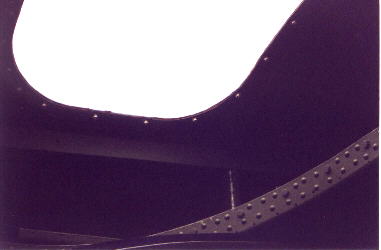
The ledge above the radioman's desk. A convenient storage space!
Entering the radio compartment I was struck by the tight confines of this space. The radioman's desk was to the left against the forward bulkhead. Two jump seats were installed opposite and facing the desk. Above the forward hatch was an empty compartment. Phil Anderson, a veteran of the 486th Bomb Group (H), told me he used to hide oranges behind this ledge. At altitude, in the subzero temperatures, the oranges would freeze solid. Once the aircraft had let down below 10,000 feet on the return trip he could take off his oxygen mask and savor the frozen treats (Phil impressed upon me how bad your mouth tasted after several hours with a rubber mask on your face, breathing oxygen.) I stood there and peered over the ledge. Just to make sure I put my hand up there too. Nope, no oranges! I took my seat, buckled up and waited for the flight to begin.
I snapped the picture at left through the aft hatch of the radio room. The pole at the center is the support for the ball turret. The red seats at left were modern additions and were installed just aft of the right waist gun. The support bulkhead for the tail wheel is visible just to the left of the pole. At right, the left waist gun is visible.
The waist gun was fitted with the K13 optical gun sight. Several knobs around the sight allowed the gunner to account for variables of aerial gunnery. A large knob at the rear of the sight allowed the gunner to compute deflection for relative motion of the target. To the right of the gun you can see the feed belt and the ammo box mounted on the wall.
I took the seat opposite the radio desk and was joined by two others. As we waited for the flight to begin we enjoyed some casual conversation, which ranged from aircraft to WWII history. The flight engineer offered us some ear plugs, but I declined (a decision I would later regret.)
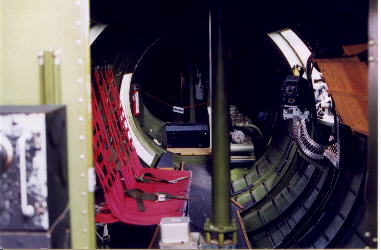
Waist area looking aft.
A few minutes later, our conversation was interrupted by the sound of engine #1 starting up. This time it caught without any hesitation. A slight smell of ozone filled the air as the starters turned the engines over. The noise built with each engine started. When all four were going the noise was very loud, bordering on the uncomfortable. The radio compartment is nestled between and slightly behind the engines. With no sound insulation the hull seemed to magnify the engine noise. The noise made all conversation impossible, but the excitement showed on our faces as we grinned approving smiles and gave each other a thumbs up. Then the noise got worse!
The pilot throttled up to full power to test the engines. The sound was tremendously loud; the vibration made the plane shake violently. It sounded and felt like the rivets were going to bust loose any second. Just when the plane was about to disintegrate, the pilot throttled back and the plane settled down. Gently, the pilot released the brakes and eased forward down the taxiway. Like the previous flights we waited for the pattern to clear. As we waited I contemplated how it must have been like sitting there waiting to start the next mission. Was it harder thinking of a target that you've been to already, or a target you haven't visited yet? Or, perhaps your thoughts were someplace else you'd rather be.
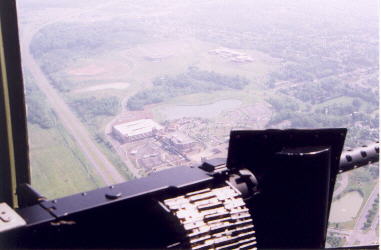
Right waist gun.
One more time the pilot throttled up to do his final checks. Military aircraft were built with one purpose in mind and performance mattered. Sound proofing reduced payload, mufflers reduced engine power! Modern aircraft had spoiled me I realized as the sound threatened to burst my eardrums.
The pilot eased back and moved onto the runway pointing the bomber toward the opposite end. The engines were up at full throttle again and the propellers were grabbing air, accelerating the aircraft down the runway. The tail developed lift first and became airborne. A moment later the main gear came up and the entire aircraft was airborne. Once the gear had been raised we were free to move about.
I first moved to the waist and let the others go forward. I found that if I stood between the ribs I could stand up straight. Then I realized why they called them "waist windows." That's how high they were. Looking out all I could see was ground. I had to crouch to see the horizon; not a comfortable position to maintain for extended periods of time. The view forward was blocked by the wing, and aft by the horizontal stabilizer. The field of view was limited, but the field of fire didn't appear to be. It was hard enough for the gunner to sight an enemy aircraft, set his sight, get the lead and take the shot. Compensating for the bouncing and rolling of the aircraft, and taking care not to "hole" the gas tanks in the wings made the problem more difficult. I was starting to think luck was more important in scoring a kill than skill.
Copyright © 1998-2026, 486th Bomb Group Association.
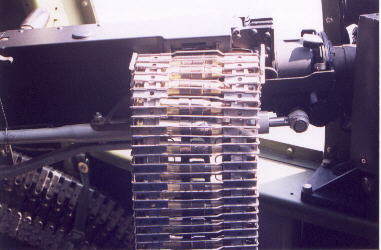
Ammo feed belt.